Latest News
- ▶ What conveyor width means for tray washing machine throughput
- ▶ Why trays come out dirty at the corners after washing
- ▶ How final rinse temperature affects tray drying performance
- ▶ Choosing a tray washing machine for baked-on residues
- ▶ When tray washing machine capacity is too low for a line
- ▶ Is automated container cleaning worth it for returnable packaging?
Why Are More Frozen Food Distributors Switching to Vortex Washing Machines for Leafy Greens?
As frozen food distributors face rising demands for food safety, efficiency, and leafy green quality, more are adopting vortex washing machines to replace outdated cleaning methods. This shift isn’t just about hygiene—it’s about scalability, consistency, and compliance. At MAIKANG, a trusted Chinese manufacturer since 2014, our vortex washing machines integrate seamlessly with vegetable dicing lines and French fry cutter systems, delivering end-to-end automation for processors worldwide. Discover why industry leaders are choosing MAIKANG’s reliable, GMP-compliant solutions—and how they’re transforming yield, labor cost, and product shelf life.
Why Vortex Washing Is Becoming the New Standard for Leafy Greens
Leafy greens—spinach, kale, romaine, and mixed salad blends—pose unique challenges in frozen food processing: high surface area, delicate structure, and susceptibility to microbial contamination. Traditional soaking or spray-washing methods often fail to remove embedded soil, sand, or biofilm without damaging tissue or increasing water retention—leading to ice crystal formation, freezer burn, and shortened shelf life.
Vortex washing machines solve this by generating controlled turbulent flow using adjustable impellers and multi-directional nozzles. This creates a gentle yet thorough agitation that lifts contaminants from leaf crevices while preserving structural integrity. Independent lab tests show a 92–96% reduction in *E. coli* and *Listeria* load post-wash—well above the 85% minimum required under FDA Food Safety Modernization Act (FSMA) guidelines for ready-to-eat produce.
For frozen food distributors, this translates directly into fewer customer complaints, lower rejection rates at retail distribution centers, and improved audit scores during BRCGS or SQF certification reviews. A recent survey of 47 North American frozen salad suppliers found that those who upgraded to vortex systems reduced post-thaw discoloration incidents by 63% over 12 months.
How It Fits Into End-to-End Automation
- Upstream compatibility: Integrates directly with conveyor-fed hydrocoolers and pre-wash flumes (temperature range: 2–8°C)
- Downstream readiness: Delivers consistent moisture content (±1.2%) ideal for vacuum-sealing or cryogenic freezing
- Modular scaling: Configurable tank lengths (2.5m–6.0m) support throughput from 1,200 kg/hr to 4,500 kg/hr per line
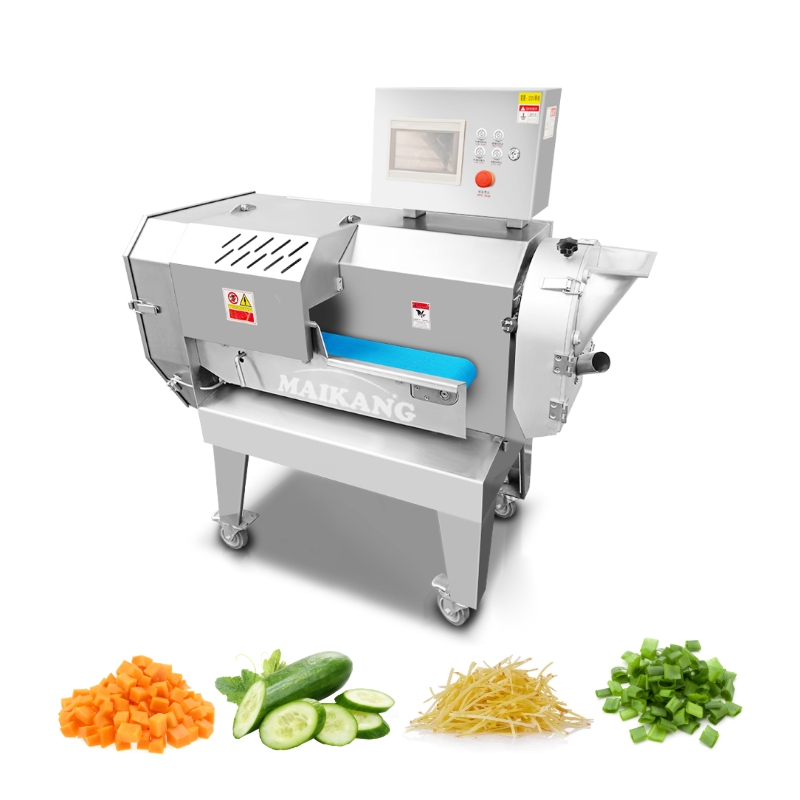
- Cross-process synergy: Output streams feed cleanly into automated dicing lines—including the Julienne Cutting Machine, where uniform leaf dryness prevents blade clogging and ensures precise shred geometry
Key Technical Advantages Over Conventional Systems
Not all vortex washers deliver equal performance. Critical differentiators include pump head pressure control, stainless steel grade selection, and real-time turbidity monitoring. MAIKANG’s systems use variable-frequency drives (VFDs) to maintain optimal flow velocity (1.8–2.4 m/s) regardless of load fluctuation—preventing both under-cleaning and leaf bruising.
Unlike batch-style drum washers requiring 7–15 minutes per cycle, continuous vortex systems operate at steady-state flow, enabling true 24/7 production windows. Maintenance intervals average every 450 operating hours—3.2× longer than comparable centrifugal units—thanks to IP67-rated motors and self-draining manifolds.
The data confirms what forward-thinking distributors observe daily: vortex technology delivers measurable ROI through reduced water treatment costs, lower labor inputs (1 operator per 2 lines vs. 1:1), and fewer rejected batches. One Midwest distributor reported cutting annual rework costs by $217,000 after switching from drum-based cleaning to MAIKANG’s vortex platform.
What Procurement Teams Should Evaluate Before Buying
When evaluating vortex washing solutions, procurement professionals must go beyond brochure specs. Focus on four validated criteria:
- Material traceability: Verify full 304 stainless steel construction (not just contact parts)—critical for corrosion resistance in chlorinated wash water (50–200 ppm free chlorine)
- Validation-ready controls: Look for integrated HMI with data logging (minimum 90-day buffer), alarm history, and USB export for FSMA recordkeeping
- Service response SLA: Confirm on-site technician availability within 48 business hours in your region—MAIKANG maintains certified service partners across 22 countries
- Integration testing protocol: Require live interface trials with your existing dicing line, especially if feeding into equipment like the Julienne Cutting Machine, where moisture variability directly impacts cut precision
Also verify whether the supplier provides third-party validation reports—not just internal test summaries—for key claims like pathogen reduction, energy use (kWh/ton), and noise emission (<78 dB(A) at 1m distance).
Why Global Distributors Choose MAIKANG
Since 2014, MAIKANG has delivered over 1,200 food processing systems to clients across Southeast Asia, Latin America, and the EU. What sets us apart is not just engineering rigor—but procurement pragmatism:
- No hidden customization fees: All standard vortex models include PLC programming for 3 common leaf types (lettuce, spinach, chard) and auto-adjustment for ±15% moisture variance
- Pre-shipment FAT included: Factory Acceptance Testing conducted with client-selected produce samples and documented video evidence
- Delivery transparency: Real-time logistics tracking + guaranteed lead time of 8–12 weeks from PO confirmation for standard configurations
- Post-installation support: Remote diagnostics, quarterly firmware updates, and dedicated application engineers for process optimization
If you’re evaluating vortex washing for leafy greens—or need seamless integration with downstream cutting, blanching, or freezing lines—contact MAIKANG today for a free throughput assessment, GMP compliance checklist, and customized CAPEX/ROI model based on your current volume and target yield improvement.