Latest News
- ▶ Do modular cooking tunnels simplify future line expansion?
- ▶ Safety interlocks a steam tunnel cooking machine should include
- ▶ When a steam tunnel cooking machine needs CIP integration
- ▶ Why food exits a steam tunnel undercooked on one side
- ▶ How humidity control protects texture during steam cooking
- ▶ Choosing a steam tunnel cooking machine for delicate products
The Definitive French Fry Cutter Guide: Everything You Need to Know
1. Definition and Core Concepts
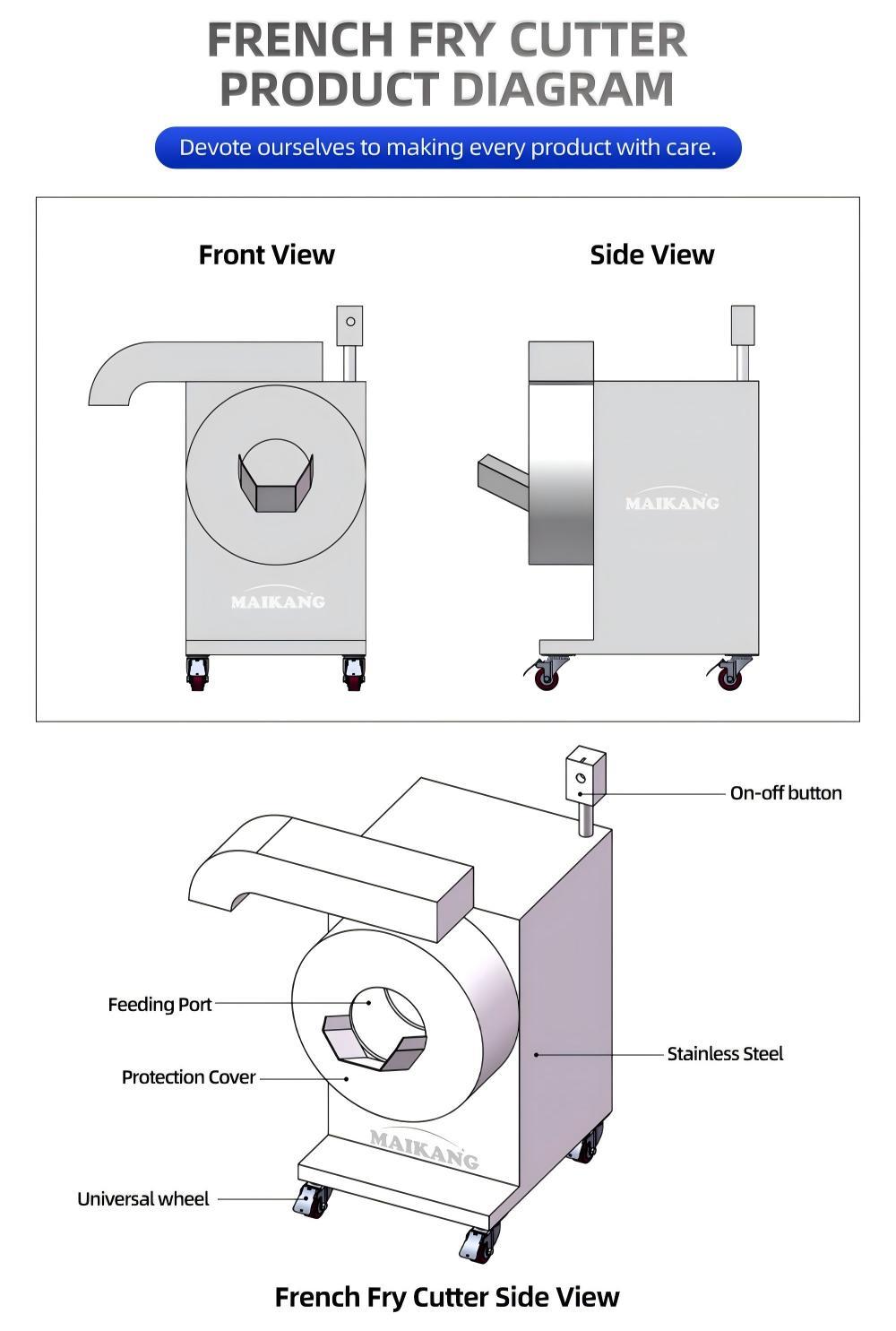
A French Fry Cutter is a specialized piece of food processing equipment engineered to shear whole raw potatoes and other root vegetables into uniform longitudinal strips. Unlike manual knife slicing, which introduces substantial variance in dimensions, mechanical cutters utilize a structural grid of high-tensile blades coupled with a linear or centrifugal pushing force.
In commercial and industrial food sectors, this equipment is a critical financial lever. Uniform dimensions ensure predictable thermodynamics during the blanching and deep-frying processes. If the cut dimensions vary by even a few millimeters, smaller pieces overcook and absorb excess oil, while larger pieces remain undercooked and starchy in the center.
Furthermore, a clean, mechanical shear minimizes the rupture of cellular walls within the potato parenchyma. Clean cuts retain vital starches inside the vegetable rather than washing them away into the process water, directly maximizing crispness and product yield while reducing oil degradation in the fryer.
2. Mechanical Principles and Driving Forces
The operational engineering of potato processing machinery revolves around overcoming the natural structural density and starch friction of root vegetables. The force required to execute a clean cut depends on the blade sharpness, the surface area of the blade grid, and the velocity of the push mechanism.
Equipment configurations generally diverge based on how this linear or centrifugal force is generated and sustained. When conducting a facility audit or planning a startup kitchen, procurement managers must evaluate the trade-offs between manual leverage and automated linear thrust. For a detailed breakdown of capital expenditure versus long-term labor efficiency, refer to our comprehensive technical report:
Manual Lever Systems
Manual cutters rely strictly on mechanical advantage, utilizing a long-handle lever or rotary cam to multiply human force. The operator places a potato in the cradle and manually forces a pusher block against a fixed blade grid. While these systems feature excellent reliability due to zero electrical components, they introduce substantial human variance. Erratic pushing speeds can lead to uneven product surfaces, structural bruising, and high operator fatigue during prolonged shifts.
Automated Drive Systems
Automated configurations eliminate human variance by providing a constant linear velocity and continuous thrust throughout the entire cutting stroke. For growing businesses, migrating away from manual labor is crucial to protecting operational margins and maintaining high-speed consistency. To understand how automated systems scale production, see our specialized analysis on the
3. Product Classification and Metallurgy
Potato processing machinery is categorized by its structural capacity, power rating, and metallurgical composition. Selecting the wrong material grade or grid size can lead to premature equipment failure, food safety violations, or poor product quality.
Chassis Metallurgy
Verifying the exact metallurgy of the chassis and load-bearing components is vital for long-term sanitation and structural compliance under high-pressure loads. Buyers frequently face a crucial choice regarding stainless steel composition, which we explore deeply in
Austenitic 304-grade stainless steel features a high chromium and nickel content, establishing an oxide layer that delivers superior resistance against organic acids and harsh chlorine-based sanitizers. In contrast, 201-grade stainless steel replaces nickel with manganese; while it offers higher tensile strength initially, it is highly prone to pitting corrosion and micro-stress cracks in humid commercial kitchen environments.
Blade Engineering
Beyond the chassis, blade spacing and metallurgy determine the culinary classification and subsequent cooking thermodynamics of the end product. For engineering insights into grid tolerances, read our evaluation on
Precision manufacturers utilize custom-hardened, martensitic stainless steel (such as 420J2) for blade grids, ensuring long-lasting sharpness and minimal edge rolling whether processing 1/4-inch shoestring profiles, 3/8-inch standard straight cuts, or 1/2-inch thick steak cuts.
4. Technical Parameters and Equipment Matrix
To assist procurement teams and industrial engineers in sizing processing machinery relative to facility demand, the following technical matrix cross-references operational metrics across different equipment tiers:
5. Application Scenarios and Industry Solutions
Commercial and industrial food processing demands highly specific equipment integration. Matching machine duty cycles with specific operational environments prevents costly bottlenecking.
Restaurant and QSR Solutions
For restaurant operators, the procurement framework focuses on space optimization, cycle speed, and rapid cleanup turnover during peak hours. Our field guide,
Industrial Processing Line Solutions
When moving from individual commercial kitchens to large-scale processing factories, the engineering requirements shift completely toward continuous unit operations. Large facilities should consult our industrial blueprint,
Global Supply Chain Solutions
For international supply chain managers, kitchen outfitters, and global distributors, compliance documentation and bulk pricing dictate the purchasing cycle. We have established an industry-wide roadmap in
6. Maintenance, Hygiene, and Safety Management
Neglecting equipment hygiene and preventative maintenance directly degrades product quality and increases the risk of mechanical failures or workplace accidents.
Sanitation and Preventative Maintenance
Starch accumulation creates an aggressive breeding ground for bacteria and forms a sticky residue that increases structural friction during the cutting stroke. Standard operating procedures must include strict daily maintenance workflows, as detailed in
Workplace Safety Protocols
Because these machines are engineered to slice high-density vegetables through sheer force, safety protocols cannot be overlooked by facility managers. Our operations manual,
Troubleshooting Operational Failures
When unexpected operational disruptions occur, staff must be equipped with immediate diagnostic knowledge to protect the machine's drive components. Mechanical blockages are often caused by over-sized raw materials, misaligned pusher heads, or high-starch varieties, and our troubleshooting guide,
Frequently Asked Questions (FAQs)
How can a commercial kitchen determine exactly when a blade matrix requires replacement?
Blade degradation shows up clearly in the physical quality of the cut potato. If fries exhibit ragged edges, significant starch tearing, or if the machine requires noticeably higher force or motor current to finish a stroke, the blade edges are dull.
What parameters are required for sourcing custom blade configurations from overseas manufacturers?
When ordering custom blade modules from an OEM supplier, buyers must specify the exact chemical composition of the stainless steel (e.g., 420J2 martensitic steel), hardness metrics on the Rockwell scale , exact grid dimensions in millimeters or inches, and the angle of the cutting edge.
What compliance certifications are mandatory for importing commercial cutters into Western markets?
For North American distribution, equipment must comply with NSF/ANSI Standard 8 for commercial food preparation equipment and bear UL or ETL sanitation certifications. In the European Economic Area, units require the CE mark, which proves compliance with the Machinery Directive (2006/42/EC), the Low Voltage Directive (2014/35/EU) for electric models, and Regulation (EC) No 1935/2004 for materials intended to come into contact with food.