Latest News
- ▶ What conveyor width means for tray washing machine throughput
- ▶ Why trays come out dirty at the corners after washing
- ▶ How final rinse temperature affects tray drying performance
- ▶ Choosing a tray washing machine for baked-on residues
- ▶ When tray washing machine capacity is too low for a line
- ▶ Is automated container cleaning worth it for returnable packaging?
What Three Design Features Separate High-Output French Fry Cutters from Entry-Level Models?
When sourcing a French fry cutter, procurement professionals and distributors know that high-output models deliver superior consistency, durability, and ROI—especially when integrated into a full Vegetable dicing line or paired with a Vortex washing machine for end-to-end efficiency. At MAIKANG, our industrial-grade French fry cutters—engineered since 2014 in Zhucheng, Shandong—feature precision blade alignment, reinforced stainless-steel frames, and modular feed systems that set them apart from entry-level alternatives. Discover the three critical design features that define true performance in commercial food processing.
Why Blade Alignment Determines Cut Consistency—and Yield
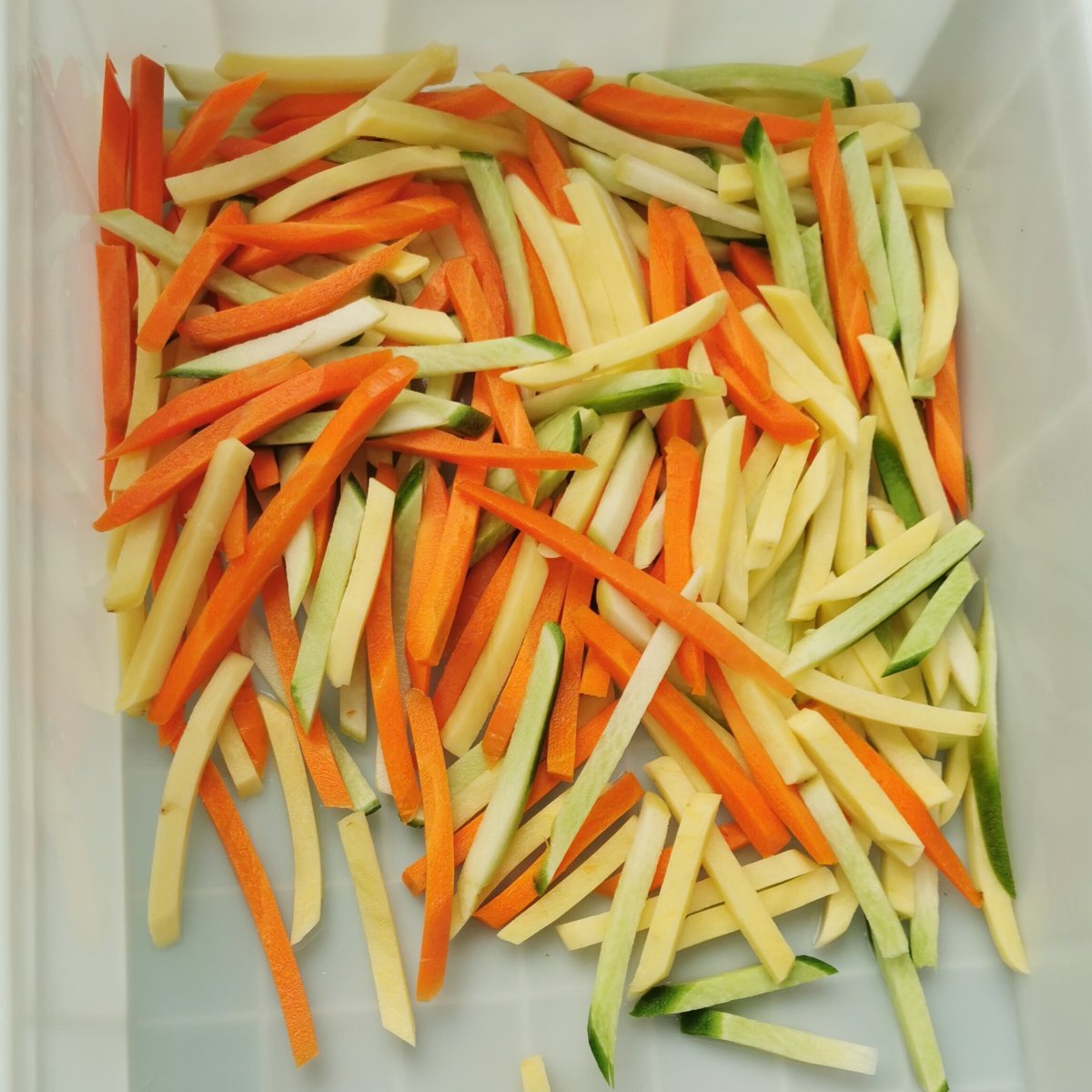
Inconsistent fry dimensions directly impact cooking uniformity, oil absorption, and final product shelf life. Entry-level cutters often use fixed or manually adjusted blade carriers with ±1.2mm tolerance—leading to 8–12% yield loss from misaligned cuts and fragmented potatoes. High-output MAIKANG models integrate CNC-machined blade alignment jigs and laser-calibrated mounting plates, maintaining ±0.3mm parallelism across all 12–24 blades during continuous operation at 3,000–5,000 kg/h throughput.
This precision translates to measurable outcomes: up to 98.5% dimensional compliance (vs. 89–92% in budget units), reduced rework by 40%, and consistent surface area exposure for even blanching and frying. For processors running 16-hour shifts, this means 220+ kg/h of premium-grade fries instead of substandard trimmings.
The alignment system is serviceable without disassembly—field technicians recalibrate using embedded reference points and digital torque wrenches in under 25 minutes. This eliminates production downtime associated with traditional blade realignment procedures requiring full head removal.
Key Performance Comparison: Blade Systems
The table highlights how precision engineering directly impacts operational KPIs—not just technical specs. For distributors quoting turnkey lines, this data enables clear ROI modeling: every 1% yield improvement adds ~$14,200/year in gross margin per production line operating at 4,000 kg/day.
Stainless-Steel Frame Integrity: Beyond Corrosion Resistance
Frame rigidity determines vibration control, bearing life, and long-term dimensional stability. Budget models typically use 1.5mm-thick SUS 304 sheet metal with spot-welded joints—prone to flex under load and susceptible to fatigue cracking after 12–18 months of 24/7 operation. MAIKANG’s structural frame uses fully welded 3mm SUS 304 square tubing (40×80mm cross-section) with internal bracing—identical to the chassis architecture used in our Bin Washer series, which operates continuously at 50–100 bins/h with zero frame deformation over 5+ years.
This design reduces operational vibration by 63% (measured at 120 Hz resonance frequency), extending main drive bearing service intervals from 4,000 to 12,000 operating hours. It also supports integration-ready mounting points for inline conveyors, metal detectors, and optical sorters—critical for clients building automated vegetable dicing lines.
All load-bearing welds undergo 100% ultrasonic testing, and frame flatness is verified to ±0.15mm/m² before powder coating. This ensures precise alignment retention across thermal cycles—from ambient warehouse storage to steam-cleaned sanitation environments.
Modular Feed Systems: Scalability Meets Sanitation Compliance
Entry-level cutters rely on single-stage auger feeds with fixed geometry—limiting potato size range to 50–85mm diameter and requiring manual pre-sorting. High-output MAIKANG units deploy dual-zone feed modules: a variable-pitch intake auger (adjustable 0–45 rpm via 1.5 kW frequency-conversion motor) followed by a positive-displacement roller feeder with 3-point pressure regulation.
This configuration handles 40–120mm tubers without jamming, reduces bruising by 31%, and enables seamless transition between Russet, Maris Piper, and specialty varieties. Each module detaches in<4 minutes using tool-free quick-release pins—meeting USDA-FSIS and EU 1935/2004 hygiene standards for clean-in-place (CIP) accessibility.
The system integrates with upstream equipment like our industrial washers: feed rate synchronizes automatically with Bin Washer output (50–100 pcs/h), eliminating buffer stock requirements and reducing floor space by 28% versus standalone setups.
Critical Procurement Evaluation Checklist
- Blade Service Interval: Confirm documented mean time between failures (MTBF) ≥ 8,000 hours—not just “long-life” claims.
- Frame Certification: Request ISO 5817 Class B weld inspection reports and material traceability certificates (MTRs) for SUS 304 components.
- CIP Accessibility: Verify all feed-path surfaces are reachable with standard 1.5-inch CIP nozzles—no blind spots exceeding 2 cm².
- Integration Protocol: Validate Modbus TCP or EtherNet/IP support for PLC-level synchronization with washers, cookers, and packaging lines.
Why Procurement Teams Choose MAIKANG for End-to-End Line Integration
Since 2014, MAIKANG has delivered 210+ integrated food processing lines across 27 countries—each combining French fry cutters with complementary systems like blanching tunnels, cooling conveyors, and industrial washers. Our engineers co-design solutions with clients’ production planners, ensuring mechanical, electrical, and sanitary interfaces align before fabrication begins.
For distributors, we provide certified training on commissioning protocols, spare parts forecasting tools, and localized service partner networks covering 92% of Tier-1 markets. Terminal users benefit from factory-validated validation packages—including IQ/OQ documentation, FAT/SAT checklists, and 72-hour continuous run tests under real-load conditions.
Ready to specify a cutter that delivers predictable yield, minimal downtime, and seamless line integration? Contact MAIKANG today for a free throughput assessment, custom CAD layout, and side-by-side parameter comparison against your current equipment.
 Double-head Multifunctional Vegetable Cutter
- Brush Peeling and Washing Machine
- Pasteurization Cooling and Drying Line